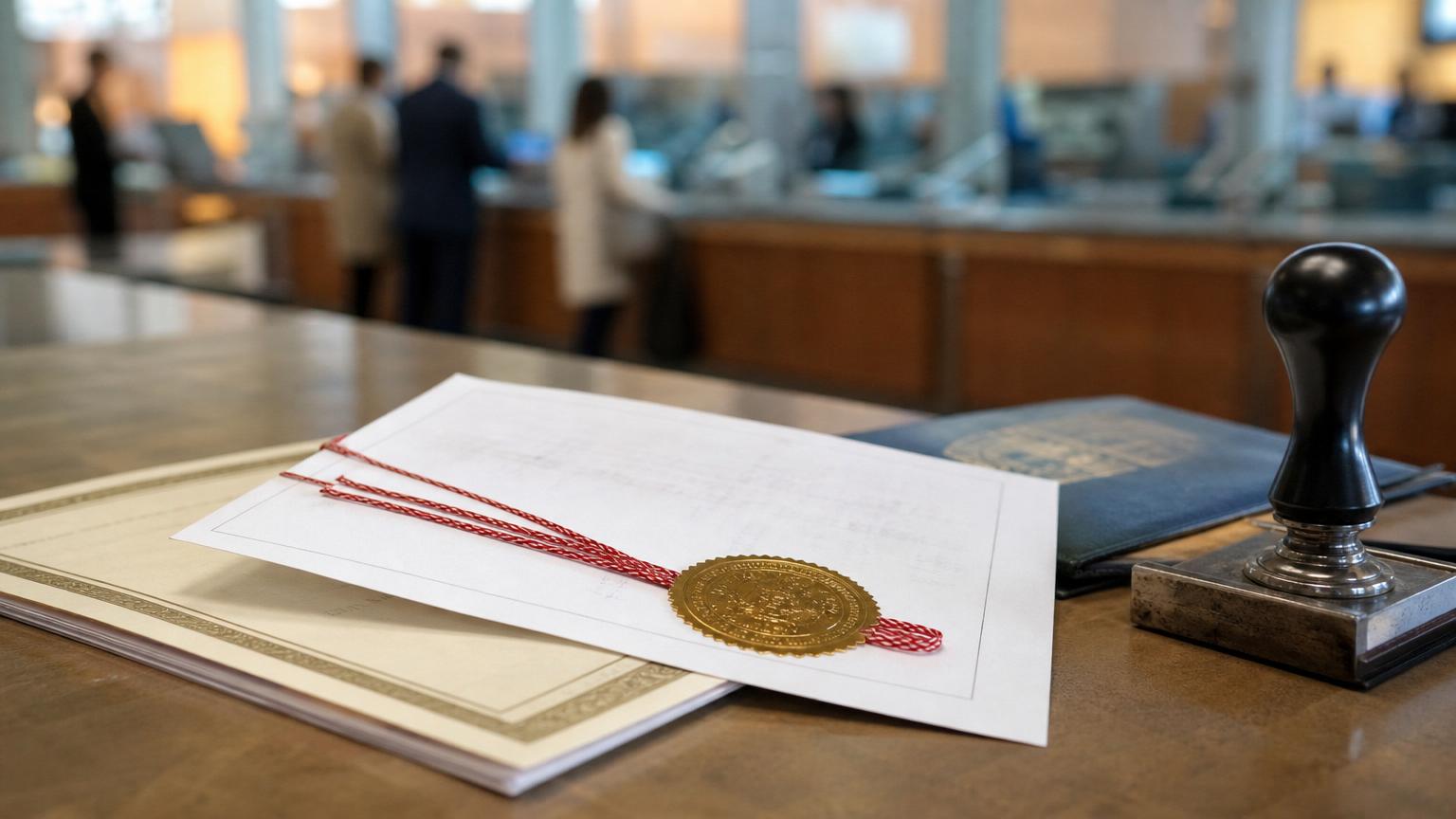
Consular & Embassy Legalization for Singapore
Using Thai documents in Singapore requires proper legalization under international law before they can be accepted. Thailand has been approved to accede to the Apostille Convention (Cabinet resolution, 9 December 2025), but the Convention is not yet in force: it still requires deposit of the instrument of accession, a six-month objection window, and entry into force 60 days afterwards. During this transition, Thai documents must still go through legalization by the Department of Consular Affairs, Ministry of Foreign Affairs (and the destination embassy in some cases), exactly as before. So during this transition, Thai documents destined for Singapore must still go through "Legalization" by the Department of Consular Affairs, Ministry of Foreign Affairs (MFA) of Thailand, and in many cases a further legalization by the Embassy of Singapore in Bangkok. NYC Legal & Notary Service handles the entire one-stop process and updates the procedure the moment the Convention takes effect.
Singapore is not a member of the Hague Apostille Convention, so documents moving between Thailand and Singapore use full Consular Legalization in both directions. Our team knows the specific document pathway for Singapore in detail.
Once in force, Thai public documents used in other member states will need only a single Apostille instead of the multi-step chain — faster and cheaper. We will update the procedure the moment it becomes legally effective. This guide summarizes everything you need for Singapore: which documents can be legalized, the exact step-by-step sequence, the document checklist, processing time, indicative fees, the translation language (English), and Singapore-specific FAQs — so you can plan accurately and avoid wasted trips.
Document checklist for Singapore
Basic documents for Singapore
- Valid passport (not expired)
- Thai national ID card and a copy of the house registration (Tabien Baan)
- Original document issued by a Thai government authority
- Certified English/destination-language translation by a registered translator
- Application form for Singapore (prepared by our team)
Purpose-specific documents
- Birth / marriage / divorce certificate (family or dependent-visa cases)
- Police clearance / criminal record check (work or residence cases)
- Transcript / degree certificate (study or qualification recognition)
- Company affidavit / power of attorney (business or corporate cases)
Step-by-step process for Singapore
- 1Consultation & case assessmentTell us how the document will be used in Singapore; we assess the pathway and price for free.
- 2Prepare / obtain originalsSource original government documents or certified copies from the issuing authority.
- 3Translate & certify translationTranslate into English/English by a registered translator with certification.
- 4Thai MFA legalizationLegalize at the Department of Consular Affairs, Thai MFA.
- 5Singapore embassy legalizationSubmit the document to the Embassy of Singapore in Thailand (สถานเอกอัครราชทูตสิงคโปร์).
- 6QA + deliveryQuality control and dispatch via EMS/DHL with a tracking number.
Why Thai documents must be legalized before use in Singapore
Government agencies, universities, employers and courts in Singapore must be confident that a submitted document is genuine and was truly issued by an authorized Thai authority. The chain of authentication is the mechanism that lets documents cross borders legally. Skip any step and the document is rejected immediately on arrival in Singapore.
Because the Apostille Convention is not yet in force for Thailand (accession was approved by the Cabinet on 9 December 2025), legalization during the transition must still pass through the Department of Consular Affairs (Thai MFA) as the main checkpoint, and in many cases must be followed by endorsement from the Singapore embassy (สถานเอกอัครราชทูตสิงคโปร์) for an additional layer of verification. NYC Legal manages every checkpoint in one place.
For Thai nationals or foreign clients already living in Singapore, we work fully online-coordinated — simply send your original documents back to our Bangkok office, our team completes every certification step, and we ship the finished documents back to your address in Singapore via DHL.
Language and translation for Singapore
Documents used in Singapore generally must be translated into English or English, depending on the receiving authority's requirements. Translation must be performed by a registered translator with a certification stamp, because substandard translation is one of the leading causes of document rejection.
Our translation team covers the world's major languages and works with NAATI translators, Ministry of Justice (MoJ) registered translators and sworn translators, so the translations we produce are accepted by embassies and authorities in Singapore.
Processing time and indicative fees (Singapore)
The full end-to-end process for Singapore typically takes about 5–15 business days, depending on the number of documents, the language, and whether embassy legalization is required. Express handling is available for urgent cases.
Indicative fees: Thai–English translation THB 500–1,200/page, other languages THB 800–2,500, consular fee THB 200–800/set, consular legalization service THB 2,500–5,000/person. If embassy legalization is also required, add embassy fee THB 1,800–2,600/set, embassy handling THB 5,000–12,000, domestic shipping THB 100, worldwide THB 2,500.
Who needs document legalization for Singapore
The most frequent cases we handle for Singapore are employment (work permit, professional registration, employer background verification), study (university admission, credential recognition, scholarship reporting), family matters (marriage registration, spouse or dependent visas, birth registration of a child born in Thailand), and business (company affidavits, board resolutions, powers of attorney, distributor or tender documents). Each of these has a different receiving authority in Singapore, and each authority sets its own tolerance for how the certification chain must look on the page.
Academic files are the most time-sensitive: Singapore intakes have fixed deadlines, and a transcript that arrives one week after the cut-off is treated exactly like a document that was never sent. We check these constraints during the free case assessment before any fee is charged, so you are never paying to certify the wrong document.
If you are unsure which of your documents actually needs legalization, send us photographs of the request letter or checklist you received from Singapore. In most cases the receiving authority has already told you the answer in wording that is easy to misread, and one review saves a full round of unnecessary certification.
Common mistakes that cause rejection in Singapore
Around four out of five rejections we are asked to rescue come from the same short list: submitting a photocopy where the receiving authority in Singapore required a freshly issued original; a translation produced by someone who is not a registered translator, so the certification stamp carries no weight; names transliterated inconsistently across passport, ID card and certificate; a document legalized in the wrong order (embassy before the Thai MFA rather than after); and certificates that were already too old on the day of submission.
A second, less obvious failure is stapling or unstapling a legalized set. Once the Thai MFA or the Singapore embassy has bound and sealed a set, removing the staple voids the seal and the whole set must be redone.
Our pre-submission QA exists specifically to catch these before money is spent: we compare every name, date, document number and seal against the source document and against your passport, and we confirm the required order of certification with the receiving authority's current published requirements for Singapore.
Validity, copies and re-legalization for Singapore
A legalization stamp itself does not expire, but the document underneath it often does in the eyes of the receiving authority. Police clearance certificates, medical certificates and civil-status extracts are commonly required to be no more than three to six months old at the moment of submission in Singapore. Educational certificates and birth certificates are generally accepted regardless of issue date, because the underlying fact does not change.
If you need the same document at two different authorities in Singapore, ask for two legalized sets from the start. Producing a second set later means repeating the entire chain — new original, new certified translation, new Thai MFA legalization and, where applicable, new embassy endorsement — which costs far more than adding a duplicate set to the first submission.
Should a document already legalized for another country need to be reused for Singapore, it usually cannot simply be transferred: an endorsement addressed to one embassy is not evidence for another. We will tell you honestly during assessment whether your existing set can be reused or whether a fresh chain is genuinely required.
How NYC Legal verifies each Singapore file
Every file is handled by a named case owner who stays with your documents from intake to delivery, so you are not re-explaining the case to a new person at each step. Translations are produced by registered translators — NAATI-certified, Ministry of Justice registered or sworn translators depending on the language and the receiving authority in Singapore — and are then reviewed a second time by a different linguist before certification.
Before any submission to the Department of Consular Affairs or to สถานเอกอัครราชทูตสิงคโปร์, the file passes a written QA checklist covering document originality, name consistency against the passport, date validity windows, translation certification wording, page order and set binding. We photograph each set at hand-over so there is a record of the exact condition in which it was submitted.
After delivery we keep a secure record of the case for future reference, which means a repeat request for Singapore — a renewal, a second authority, or a family member with the same document type — can be prepared much faster and with the wording that has already been accepted once.
Frequently asked questions — Singapore
Is Thailand a party to the Apostille Convention yet?
Thailand has been approved to accede to the Apostille Convention (Cabinet resolution, 9 December 2025), but the Convention is not yet in force: it still requires deposit of the instrument of accession, a six-month objection window, and entry into force 60 days afterwards. During this transition, Thai documents must still go through legalization by the Department of Consular Affairs, Ministry of Foreign Affairs (and the destination embassy in some cases), exactly as before. Once in force, Thai public documents used in other member states will need only a single Apostille instead of the multi-step chain — faster and cheaper. We will update the procedure the moment it becomes legally effective.
Do Thai documents for Singapore need an Apostille or consular legalization?
Singapore is not an Apostille member, so full consular and embassy legalization is required — an Apostille stamp cannot be used instead.
How long does legalization for Singapore take?
On average 5–15 business days depending on the number of documents, the language (English), and whether Singapore embassy legalization is required. For urgent cases contact our team via Line @NYCLI for express scheduling.
Which language do I need to translate documents into for Singapore?
Most documents are translated into English or English per the receiving authority's requirements, and must be produced by a registered translator with a certification stamp.
I already live in Singapore — can I still use the service?
Yes. We provide a fully online-coordinated service: send your original documents to our Bangkok office, we complete every certification step, then ship via DHL back to your address in Singapore.
Where is the Singapore embassy in Thailand?
สถานเอกอัครราชทูตสิงคโปร์ — our team submits documents for legalization directly, so you do not need to travel there yourself.
How much does legalization for Singapore cost?
It depends on document type and quantity. Translation starts at THB 500–2,500, consular fee THB 200–800/set, handling THB 2,500–5,000. Embassy legalization adds the actual embassy fees. Get a free quote via Line @NYCLI.
What if my document is rejected in Singapore?
Acceptance is decided by the receiving authority, so no provider can promise an outcome. Our scope of responsibility is stated in writing: if a rejection is caused by an error on our side, we redo the work at no extra charge.
How long does a legalized document stay valid for Singapore?
The legalization itself does not expire, but the receiving authority in Singapore usually judges the age of the underlying document. Police clearance certificates, medical certificates and civil-status extracts are typically required to be no older than three to six months at submission, while degree and birth certificates are normally accepted regardless of issue date.
Can I legalize a photocopy instead of the original for Singapore?
Only when the receiving authority in Singapore explicitly allows a certified true copy. Where an original is required, a copy — even a notarized one — is rejected on sight. We confirm which of the two your specific authority accepts during the free case assessment before any work starts.
I need the same document at two authorities in Singapore. What should I do?
Request two legalized sets in the same submission. Producing a second set later restarts the entire chain — new original, new certified translation, new Thai MFA legalization and, where applicable, a new endorsement from สถานเอกอัครราชทูตสิงคโปร์ — so ordering both at once is substantially cheaper and faster.
What happens to my case once the Apostille Convention takes effect for Thailand?
Once in force, Thai public documents used in other member states will need only a single Apostille instead of the multi-step chain — faster and cheaper. We will update the procedure the moment it becomes legally effective. Once it is in force, Thai documents for Singapore will need a single Apostille instead of the MFA-plus-embassy chain where Singapore is a member state. We track the entry-into-force date and will route your file through whichever pathway is legally valid on the day of submission.
Can you collect the original document from a Thai government office for me?
Yes. For most civil-registry, education and police records we can obtain the freshly issued original on your behalf with a power of attorney, then move straight into translation and legalization for Singapore. This is the usual choice for clients who are already abroad.
Related services
How document legalization works in Thailand
Thailand is a party to the Apostille Convention only from a limited perspective, so the practical route for most Thai documents used abroad remains full consular legalization rather than a single apostille stamp. The standard chain is: (1) translation and notarial certification, (2) authentication by the Legalization Division of the Ministry of Foreign Affairs at Chaeng Watthana, and (3) authentication by the destination country's embassy or consulate accredited to Thailand. Getting the order and the prerequisites right at each stage is what separates a smooth two-week process from months of back-and-forth.
The Ministry of Foreign Affairs Legalization Division applies strict source-document rules: originals or MFA-acceptable certified copies only, translations that meet its formatting standards, and, for many civil-status documents, a preceding certification from the issuing Thai authority. Because MFA counter capacity is limited and same-day slots are competitive, we pre-screen every file against the current MFA checklist so documents are accepted on first submission rather than returned at the counter.
Each embassy layer adds its own requirements — appointment systems, fee schedules, sworn-translation preferences, and in some cases a requirement that the translation be produced by a translator on that embassy's approved list. We maintain current, embassy-specific checklists for the missions most used by our clients (US, UK, EU member states, Australia, and the Gulf states) so the final authentication step is predictable rather than a gamble.
Our end-to-end process
We treat every document legalization case as a managed file rather than a single transaction. Documents are logged, checked against the current requirements of the specific receiving authority, and tracked through each certification stage. For clients overseas the entire process is handled remotely: you never need to travel to Thailand, and finished originals are returned by EMS domestically or DHL Express worldwide with tracking.
Accuracy, compliance and verifiability
Compliance is not an afterthought in this work — it is the product. A document that is beautifully translated but authenticated in the wrong order is worthless to the receiving authority, so we verify the exact requirement of the destination (which certifications, in which sequence, within which validity window) before we begin. Where an authority's rules are ambiguous, we confirm directly with the relevant mission rather than assuming, because a rejected submission costs the client both time and courier fees.
Common mistakes we help you avoid
A second frequent error is authenticating documents in the wrong order — for example obtaining an embassy authentication before the Ministry of Foreign Affairs step it depends on, which forces the whole chain to be redone. Mapping the correct sequence in advance is inexpensive; unwinding an out-of-order chain is not.

Transparent, itemised pricing
We price to the destination's real requirements, never gold-plating a file with unnecessary steps. Where a simpler route satisfies the receiving authority, we recommend it; where a fuller chain is genuinely required, we say so before work begins. That honesty, combined with itemised quoting, is what keeps repeat and referral clients returning.
Realistic timelines you can plan around
Realistic turnaround is a function of the chain length. Standard notarial certification and certified translation are typically completed within one to a few business days; adding MFA legalization extends the timeline by several business days depending on counter availability; and destination-embassy authentication adds the mission's own processing time. For urgent files, express handling and priority courier options can compress this materially, and we will tell you honestly at quotation whether your deadline is achievable.
Why it pays to get it right the first time
The value we add to document legalization is certainty: you know before you commit exactly what your destination requires, what it will cost, and how long it will take. That certainty — backed by licensed attorneys, accredited translators and verifiable certifications — is why clients in more than a hundred countries trust us with documents that cannot afford to be rejected. Start with a free, no-obligation quote via Line @NYCLI.
แหล่งอ้างอิงที่เชื่อถือได้
NYC Legal ดำเนินการตามกฎหมายและระเบียบของหน่วยงานราชการที่เกี่ยวข้อง